

Our finishes
Deburring
Deburring is a finishing process that removes burrs and irregular edges from metal components.
Our Strengths
Deburring Applications
Operational Safety Complete elimination of sharp edges and cutting burrs to ensure the safe handling of components along the assembly line.
Perfect Mechanical Fit Guaranteed correct interference between components by removing imperfections that could compromise the assembly process.
Consistent Results A standardized process that ensures the same edge quality across large batches, from the first piece to the last.

deburring:, process and characteristics
_ deburring process e characteristics
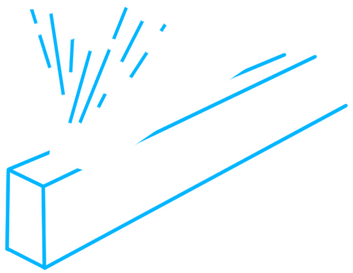
The deburring process is a critical stage in material processing, involving the removal of burrs—excess material found on products created through molding, machining, or cutting operations.The primary objective of deburring is to refine the workpiece, aiming to eliminate excess material along contours and joints.Furthermore, this process straightens the edges of machined parts by mechanically removing all imperfections resulting from casting, cutting, and molding.Deburring is therefore essential to ensure the perfect shape of the component before proceeding with subsequent surface treatments.Its execution requires extreme precision and attention, especially for complex geometries, as inaccurate processing could compromise both the functionality and aesthetics of the final part.In addition to burr removal, deburring also contributes to enhancing product safety and reliability by eliminating potential weak points or the risk of damage during use.
The correct execution of the deburring process requires careful planning and an accurate selection of tools and techniques to ensure optimal results in terms of shape, finish, and functionality of the machined parts.Continuous research into innovation and process improvements is essential to meet growing market demands and maintain high quality standards within the industrial sector.
l Industries Served
Automotive
Plumbing & Fittings
Aerospace

machinery
and controls utilized
_ machinery
and controls
utilized

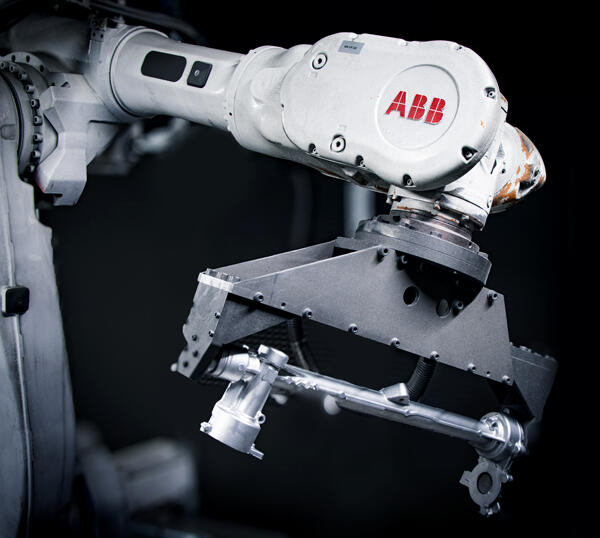
l ABB Robot
The 6-axis robotic arm guides rotating tools along metal edges, while force sensors on the wrist detect contact pressure, allowing the robot to adapt its trajectory and speed in real time. 3D scanners or vision systems map the geometry of the workpiece, automatically identifying the areas to be treated and generating optimal tool paths. The system guarantees complete deburring without damaging intact surfaces, automatically retracting in case of overload.
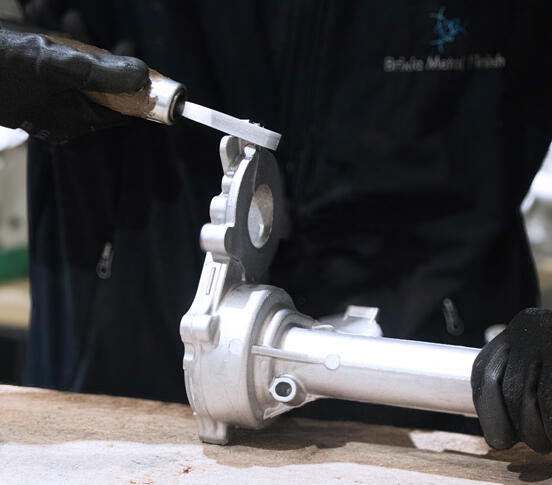
l Power Filers, Backing Pads, Angle Grinders
This mechanical finishing operation utilizes high-speed rotating tools (such as cylindrical burs or rotary files) to remove burrs, sharp edges, and weld beads from metal workpieces. Applied with controlled pressure to the surface, the tool scrapes away excess material through abrasion until crisp fillets or smooth surfaces are achieved. It is essential to modulate speed and pressure to prevent excessive removal of the base material, localized overheating (which could alter the metallurgical properties of the component), or premature tool wear.
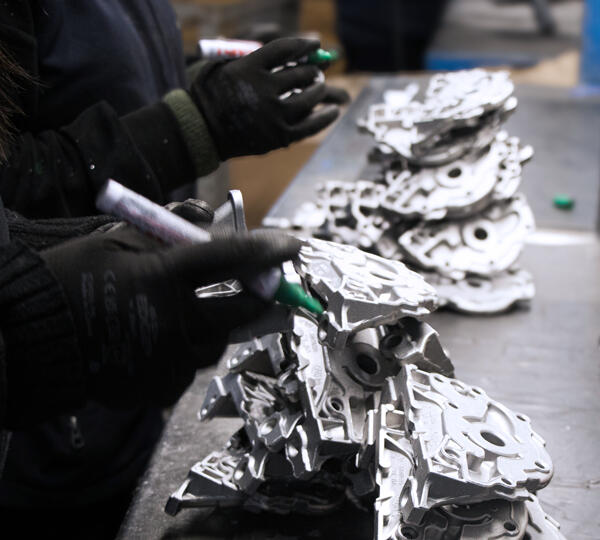
l Visual Inspection
Visual inspection during the filing process is performed by the operator using a task lamp and a magnifying glass under tangential lighting conditions to highlight micro-irregularities. After filing, the operator verifies the effective removal of metallic residues, surface roughness, and the integrity of the final profile, identifying any chipping, insufficient chamfering, or untreated areas. This process allows for the rejection of non-compliant parts and provides timely feedback on machining parameters to be corrected, optimizing overall production quality.

_ link & download
_ link &
download

Download informative materials and specifications to learn more about our processes, our methodology, and how we guarantee our high quality standards:
Industries Served
Procedures & Quality

_ FAQ _
(Frequently Asked Questions)
_ FAQ
(Frequently Asked Questions)


Via Collebeato 22 | 25127 Brescia | ItalyP.Iva C.F. 04150990986 | Rea BS 592530 | Cap. Soc. 20.000 I.V.
